
Clinton Township, MI · Garage Door Service
What Breaks First in a Clinton Township Garage Door
Clinton Township homes date mostly to 1957; cold winters stress old garage doors. See what drives failure, cost factors, and when replacement beats repair.
- Repairs & new doors
- Springs & openers
- Serving 5 nearby communities
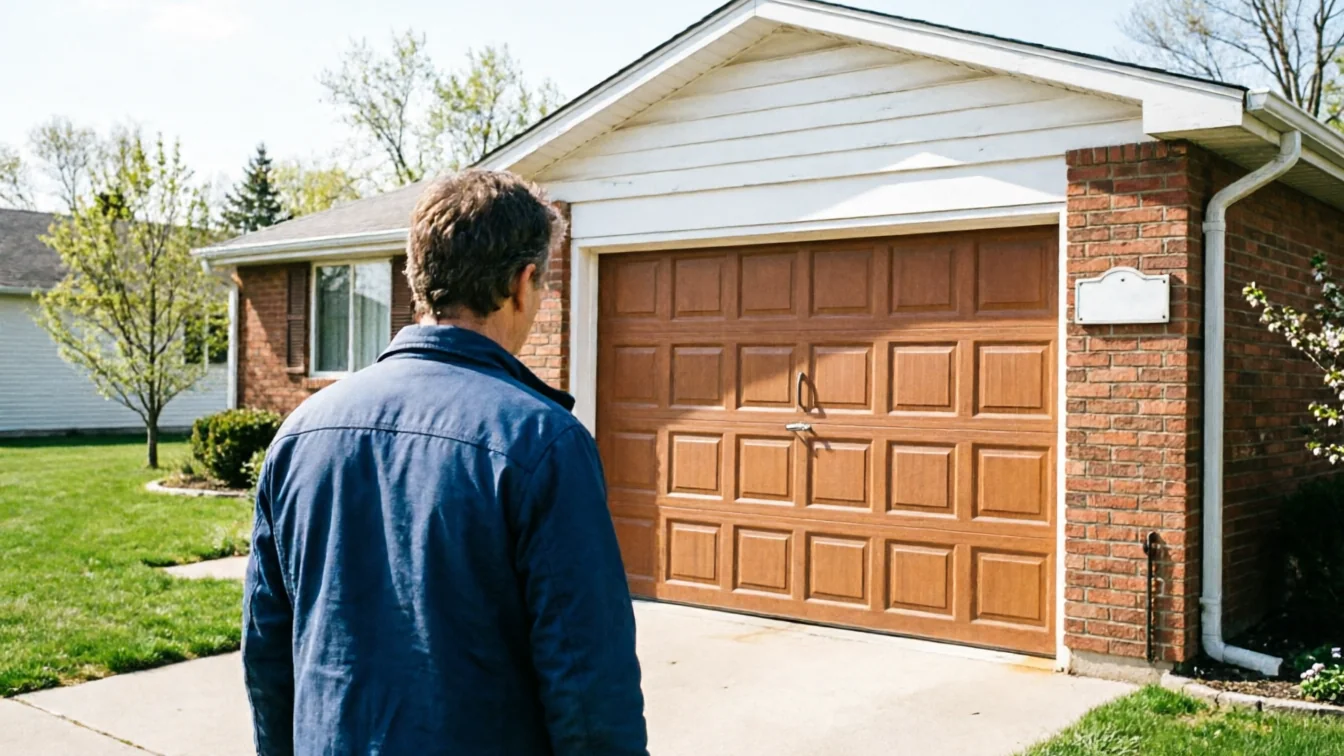
The Problem
Housing in this part of Macomb County spans 1938 to 2002, but the typical house here dates to 1957. That number matters more than it sounds like it should. A door and opener installed on a house built in the late 1950s has usually been replaced once already, maybe twice, and whatever is on the track now is often a builder-grade single-layer steel door hung on side-mounted torsion hardware that nobody stocks new parts for anymore.
Across the 35 older neighborhoods that make up this service area, pre-1960 construction is the rule, not the exception. That means narrow garage openings sized for cars from another era, headroom that doesn't leave room for a modern torsion tube without modification, and framing that has shifted enough over sixty-plus years to throw tracks out of square. None of this shows up as a single dramatic failure. It shows up as a door that's gotten louder, a spring that's been recoiled once already, or an opener pulling harder than it used to.
The honest version of this section is that a door failing on a 1957-era house isn't really one problem. It's usually three small ones stacked up - old spring, worn rollers, a track that's slightly bent - and treating only the loudest one buys you a few months, not a fix.
What the Weather Here Does to It
Clinton Township sits in a climate band classed as cold and severe, and a garage door takes that differently than most of the house does. The door is the largest moving object on the building envelope, and it's the one part of the house designed to seal against the ground, where cold settles and where meltwater refreezes.
On the older stock that dominates this area, that cycle works on two specific points: the bottom seal, which hardens and cracks faster once it's gone through a few winters of freeze and thaw, and the torsion spring, which loses tension more noticeably in cold steel than most owners expect. A spring that was marginal in October can snap on a January morning with no warning, because cold steel is less forgiving under load.
Tracks are the other casualty. Houses from the 1940s through 1960s commonly have garages that were never insulated, so the track hardware sits at close to outdoor temperature all winter. Grease thickens, rollers bind slightly, and the opener strains to pull a door that's moving less freely than it did in summer. None of that is dramatic on its own. Stacked together over a cold season, it's why winter is when most of these older doors finally give out.
What It Costs
We're not going to put a number on this section, because the honest answer is that it depends on what's actually on your house - and on a door built in or near 1957, what's actually there varies more than people expect. Some houses still have the original single-panel door on its original spring. Others have been through one replacement already with a newer steel door bolted onto old track and hardware, which is its own kind of mismatch.
What drives the cost conversation here isn't the brand of door, it's the age and condition of what's underneath it: whether the opening still matches a standard size, whether the existing track can be reused or has rusted and bent enough that it has to go, and whether the spring system is a simple torsion replacement or something non-standard left over from an earlier renovation. On a house this old, we won't quote a number sight unseen, because guessing wrong either way doesn't help you. A repair that's actually a replacement in disguise costs you twice; a replacement quote on a door that just needs a spring and roller set costs you money you didn't need to spend.
When to Call Someone
Call before the door fails completely, not after. On houses from this era, the signs are usually mechanical and specific: a door that's started reversing on its own partway down, a spring with a visible gap where it's separated, cables that look frayed at the bottom bracket, or an opener that's begun making a grinding sound it didn't make last winter.
If the door is original or close to it, replacement is worth considering before a full breakdown, especially with cold-weather spring failure being the common winter call in this area. A broken torsion spring under load, especially on a wider double door, isn't a weekend DIY repair - the spring is under enough tension to cause real injury, and that's not a place to save money by guessing.
If you're not sure whether what you're hearing is routine wear or a sign the door's at the end of its run, that's a reasonable thing to ask about rather than wait on. We work across Clinton Township and the surrounding communities, including Mount Clemens and Fraser nearby. You can reach out through our site.
Frequently asked questions
Why do garage doors fail more in winter here?
Cold steel loses tension faster than warm steel, so a torsion spring that was already worn tends to go in the coldest stretch of the season rather than mid-summer. Combined with bottom seals that harden and crack in freeze-thaw cycles, winter is when marginal hardware finally gives out, especially on older doors.
My house was built in the 1950s - is the door original?
It's possible, though most houses from that era have had at least one door replacement by now. What's more common is a newer door hung on the original track and spring hardware, which is its own mismatch worth having checked, since the hardware may not be rated for the door now on it.
Is it worth repairing an old door instead of replacing it?
Sometimes - it depends on whether the track and framing are still square and whether the spring system is standard or something left over from an earlier job. We don't quote a number without seeing the door, because guessing wrong either way costs you money.
Related garage door services in Clinton Township
More garage door guides
Book garage door service in Clinton Township
Call now or request a quote - tell us what the door is doing and where you are.